
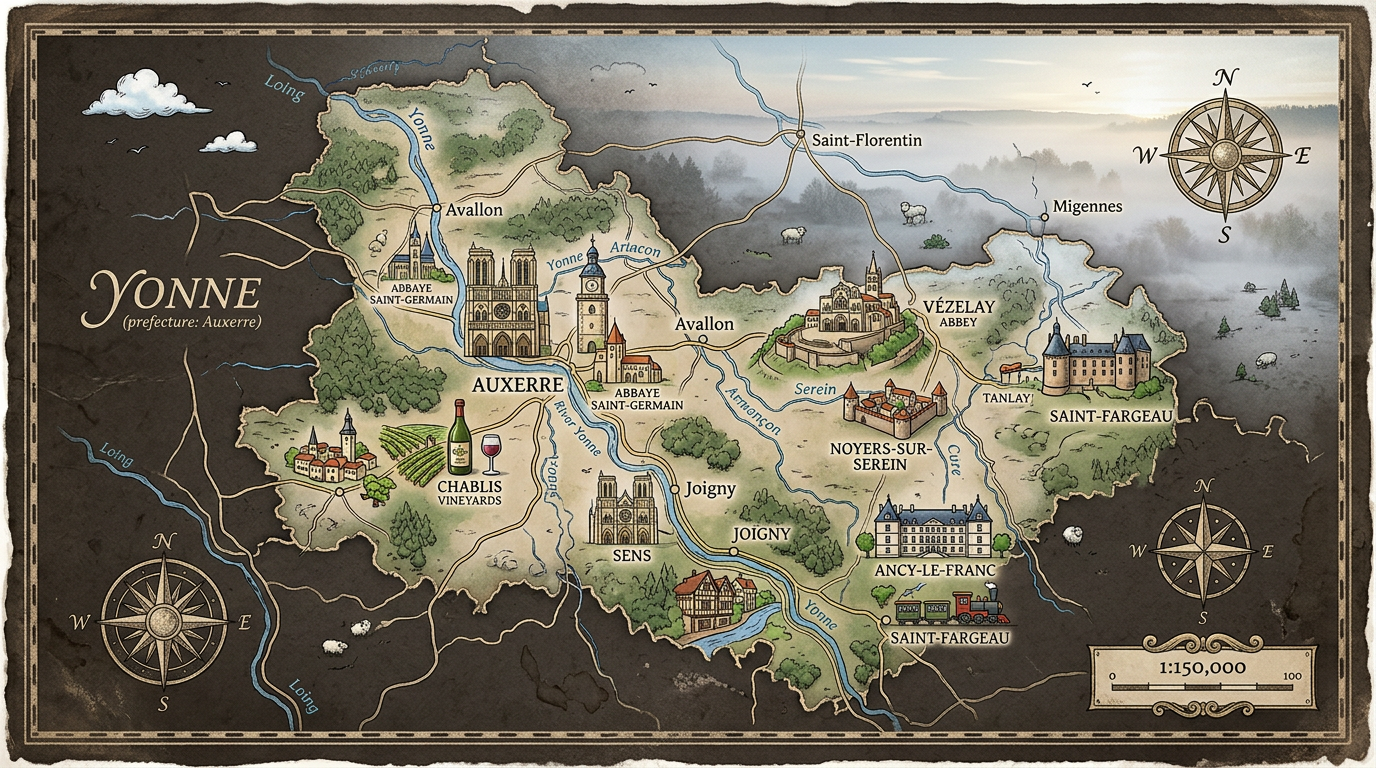
What you need to know about the Yonne department ?
We will present to you here a French department without access to the sea, that is to say without access to the sea and located right in the center of the country. In fact, it is department 89, also called the Yonne department.
The fact is that this name was given in relation to the Seine which crosses it, or more precisely the Yonne, its tributary. This department has a capital which is also, in addition, its prefecture and this capital is called Auxerre, moreover, its sub-prefectures are: Avallon and Sens. This department is governed by a president of the departmental council and also by a prefect.
Demographically, department 89 has 333,343 inhabitants, also known as Icaunais; its density is 45 inhabitants per km². This is the result of the fact that the department’s surface area is 7,427 km². Administratively, the Yonne department is divided into 3 arrondissements, 3 legislative constituencies, 21 cantons, 14 inter-municipal cooperation structures, and 423 communes.

What are the neighboring departments of the Yonne department?
Since the Bourgogne-Franche-Comté region is the region to which department 89, namely Yonne, belongs, its neighboring departments are: the department of Aube, the department of Côte-d’Or, the department of Nièvre, the department of Loiret and finally, the department of Seine-et-Marne.
What is the climate like in the Yonne department?
The Yonne department is considered to have a predominantly continental climate. This is characterized by the fact that there are many differences between temperatures. This is characterized by the fact that summer periods have high temperatures and winter periods are cool. When we talk about Auxerre, it is the city with the highest temperatures in the department, meaning that in summer, this city could have an extreme temperature of 41°C.
Although the department has an overall uniform climate, there is always a diversity of microclimates, meaning that in the western and eastern parts, as well as in the south and north, temperatures vary. This means that the Auxerrois region is somewhat warm, although the climate is almost constantly dry. On the other hand, when we talk about the Morvan, it rains a lot and one will probably experience somewhat cool weather during the summer, especially at night. On the other hand, during the winter period, there is a lot of snowfall.
What are the most important cities in the Yonne department?
For this ranking, we refer to the tourist attendance of the cities in the Yonne department. So, these 10 cities that we present to you are the 10 best tourist cities in the Yonne department.
- Auxerre
- Sens
- Joigny
- Avallon
- Tonnerre
- Villeneuve-sur-Yonne
- Saint-Florentin
- Saint-Fargeau
- Saint-Georges-sur-Baulche
- Saint-Clément
- Pimelles
- Cheney
- Savigny-sur-Clairis
What are the largest communes in the Yonne department?
To establish this ranking, we referred to the area of the communes in the Yonne department; here are the 10 largest communes of 89:
- Saint-Fargeau
- Perceneige
- Cruzy-le-Châtel
- Tonnerre
- Bussy-en-Othe
- Lavau
- Champignelles
- Treigny-Perreuse-Sainte-Colombe
- Mézilles
- Auxerre
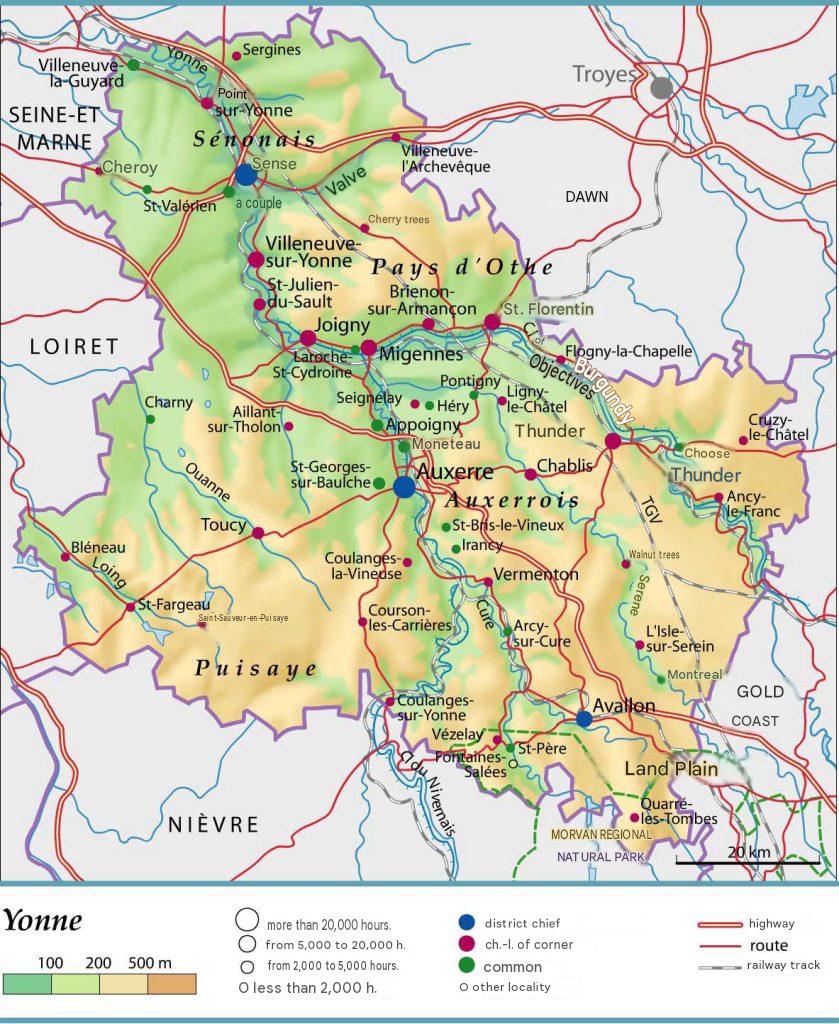
FAQ: Yonne map
The Yonne tourist office website offers detailed maps for river navigation and water-based tourism. These documents indicate marinas as well as mooring points available along the Burgundy Canal.
Yes, specific maps are published to discover renowned vineyards such as Chablis. They trace routes allowing you to visit wine estates and cellars while enjoying the scenery.
Tourist guides include maps of medieval cities like Auxerre or Avallon to facilitate your walking tours. You can pick them up directly at local tourist office information desks.
