
The Central African Republic often intrigues when discussing Central Africa. This landlocked country, with a complex trajectory, combines a significant colonial history, major current challenges, and a potential that is difficult to exploit. Exploring the daily life, social realities, and future prospects of this nation invites discovering an authentic face of Central Africa, far from simple geographical clichés.
A landscape shaped by history and geography
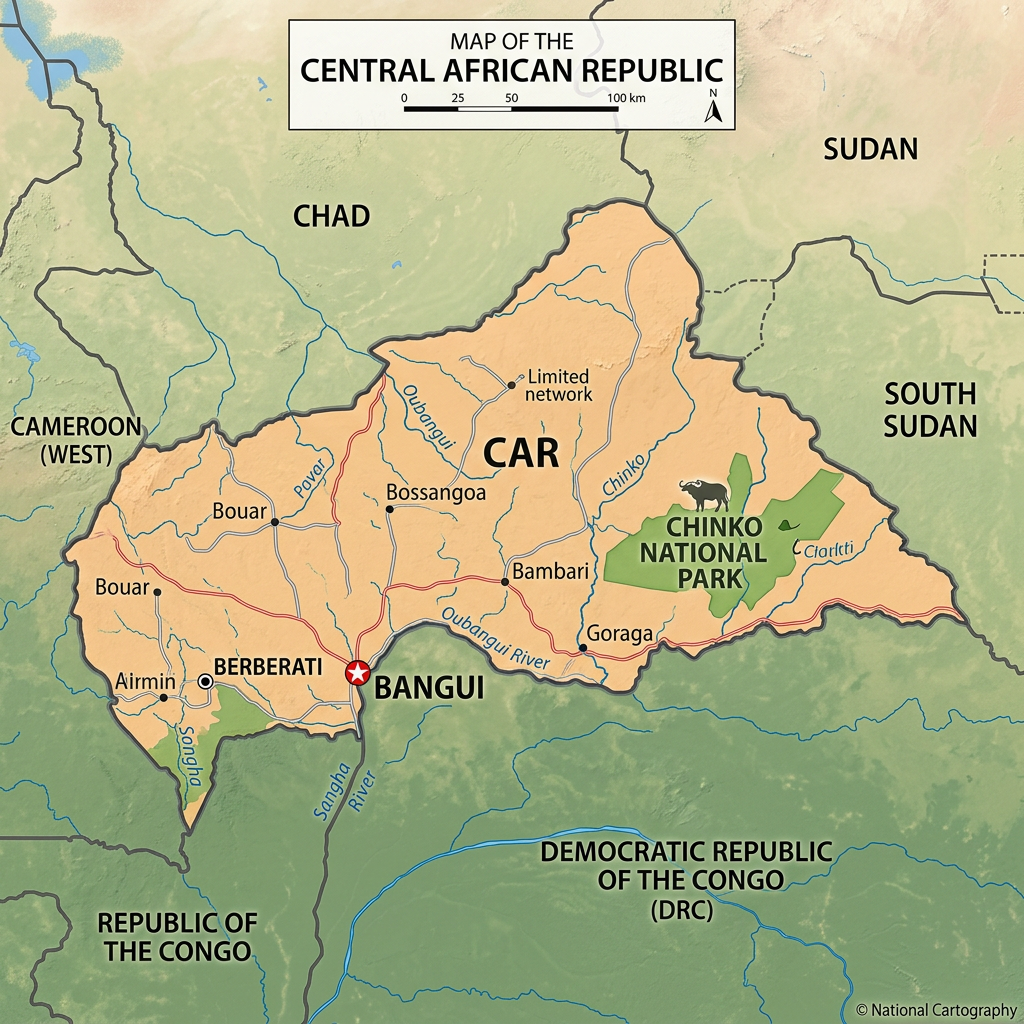
The positioning of the Central African Republic clearly illustrates its status as a landlocked country. Deprived of direct access to the sea, it shares its borders with six neighbors, which strongly characterizes economic exchanges and influences its regional relations. This geographical situation makes logistics more costly and adds difficulties for the development of efficient infrastructures.
The map of the Central African Republic highlights a landlocked country at the center of the continent. It shares its borders with Cameroon to the west, Chad to the north, Sudan and South Sudan to the east, as well as the Democratic Republic of the Congo and Congo-Brazzaville to the south. Bangui, the capital, is located on the Ubangi, a tributary of the Congo.
Table – Central African Republic: Geographical and Demographic Information
| Element | Key Information |
|---|---|
| Total area | 622,984 km² |
| Capital | Bangui |
| Neighboring countries | Cameroon, Chad, Sudan, South Sudan, DRC (Congo in your list), Congo-Brazzaville |
| Estimated population | ~5.9 million inhabitants (2025) |
| Population density | ~9 inhabitants/km² |
| Relief | Plateaus, savannas, equatorial forests in the south |
| Climate | Tropical: rainy season (May-October), dry season (November-April) |
| Official languages | French, Sango |
| Economic resources | Diamonds, gold, wood, agriculture |

Long considered a French colony, the Central African Republic still retains deep traces of its colonial past today. Schools, the administrative system, and the spread of French as an official language testify to the impact left by this period on daily life and national identity.
- Tricolor flag with bright colors unique in Central Africa
- Capital Bangui, a true cultural and economic crossroads
- Varied ethnic fabrics composing the demographic mosaic
Additional points on the map of the Central African Republic
- The CAR is a landlocked country in the heart of Africa.
- The relief is dominated by plateaus and savannas, with equatorial forests in the south.
- The demographic map shows a strong concentration around Bangui, the capital.
- The country has significant diamond and gold deposits.
- Its geographical location makes it a strategic crossroads, but also politically unstable.
What are the official languages and cultural diversity?
In the Central African Republic, linguistic diversity is observed through the coexistence of French and Sango. French directly stems from the colonial era heritage, while Sango, also recognized as an official language, mainly occupies the domestic and social sphere, thus consolidating its role as a tool for popular unification.
The ongoing dialogue between tradition and modernity shapes the local culture, giving rise to rich artistic, musical, and culinary practices. Both in cities and rural areas, the plurality of ethnic groups fuels a common passion for oral transmission and community organization. This collective experience strengthens a sense of belonging despite fragmentation sometimes accentuated by recent events.
An impressive ethnic mosaic
The population brings together more than a hundred ethnic groups, each maintaining specific traditions, beliefs, and customs. This mosaic guarantees a tremendous cultural variety, but it also raises issues related to representation and national cohesion.
Peaceful coexistence is the human wealth of the country, while requiring vigilance and constant dialogue to avoid identity-based tensions, especially during periods of political change or crisis.
Influence of religion and rituals
Diverse spiritual practices coexist in the Central African Republic. Islam, Christianity, but also animism, still alive in rural areas, are found. These different practices mark the social calendar, highlighting time with major festivals, ceremonies, and rites of passage.
Despite their diversity, these beliefs sometimes play a peacekeeping role in resolving local conflicts. They open the door to solidarity and structure the daily dynamics of villages and urban neighborhoods.
Population, demographics, and social issues
Demographics reflect both youth and fragility. The majority of the population is under twenty years old, which forces a rethink of access to education, healthcare, and employment. Such an age pyramid certainly represents an opportunity for renewal, but it also poses a colossal challenge for the government in its public policies.

Rural areas, where a large part of the inhabitants still live, suffer more from a lack of adequate infrastructure, which amplifies the exodus to the capital Bangui. These internal migrations complicate urban planning and increase poverty in some disadvantaged neighborhoods.
Poverty and development, what possible balance?
Development remains hindered by chronic instability and low economic diversification. The economy is primarily based on family farming, livestock, and very artisanal exploitation of natural resources. However, the persistence of poverty perpetuates a vicious cycle fueling precariousness, malnutrition, and difficulties accessing essential social services.

The fight against poverty requires innovative strategies, including both massive investment in education and better management of mineral wealth. Some initiatives from civil society are already trying to give voice to forgotten communities, notably through the local associative network driven by a genuine desire for progress.
Migrations, entry formalities, and regional mobility
Traveling to the Central African Republic generally involves strict procedures concerning the passport and visa, which contrasts with some other countries in the sub-region. Visitors, researchers, or humanitarian volunteers must go through several security steps to obtain temporary residence rights.
These entry formalities aim both to protect foreign nationals and to control migratory flows. For Central Africans wishing to explore abroad, mobility remains complicated due to the country’s reputation on the international stage and the difficulty in obtaining certain visas.
Political and security challenges: what governance in the face of crises?
For several years, the Central African Republic has experienced deep instability marked by the presence of rival armed groups. The clashes have weakened state authority, which is then confronted with persistent insecurity. Despite government efforts and multiple international mediation attempts, the climate remains tense in certain regions.

The public administration tries as best it can to maintain its legitimacy, even though decentralization struggles to progress effectively in all departments. This complicates the action of the Prime Minister and his team, who must navigate shifting alliances and pressing humanitarian priorities.
Armed groups and consequences for the population
The recurrence of civil war-related violence heavily impacts the daily lives of families. Many internally displaced persons live in makeshift sites, deprived of stable housing and exposed to health vulnerabilities. Road blockages sometimes make the delivery of humanitarian aid impossible.
Such conditions widen the gap between protected cities and peripheral areas left to fend for themselves. The absence of lasting peace unfortunately encourages recurring cycles of violence despite ongoing negotiations.
The role of the government and the quest for stability
Faced with insecurity, leaders relentlessly seek sustainable solutions. They regularly collaborate with international partners to strengthen the capacities of security forces and stabilize the most affected areas.
Reforming the state apparatus remains a major concern: improving transparency, ensuring judicial neutrality, and strengthening the people’s trust seem essential before any effective resumption of national development.
Perspectives and Aspirations for the Central African Republic
The Central African Republic stands at a crossroads: heir to its colonial history, torn by multiple crises, but driven by a youth eager for emancipation and innovation. Many hope to see the emergence of a generation aware of global challenges, ready to leverage natural assets while reinventing local solutions.
Discussions about development involve seeking new partners, improving public education, and supporting sectors that generate sustainable jobs. Additionally, the diaspora plays a relay role with international donors, keeping alive the idea of a better future based on peace and regional cooperation within Central Africa.
FAQ – Central African Republic Map: 3 Questions
It is located in the center of the continent, landlocked between six countries: Cameroon, Chad, Sudan, South Sudan, Congo, and DRC.
The capital is Bangui, located on the banks of the Ubangi River.
The CAR is distinguished by its savannas, equatorial forests in the south, and plateau relief.
