
South Sudan often intrigues those interested in contemporary Africa. This young country, recently independent, remains marked by a complex history as well as particular demographic, political, and cultural dynamics. From its recurring armed conflicts to the richness of its linguistic diversity, the territory arouses as much concern as fascination.
A recent history shaped by independence
The creation of South Sudan is no trivial matter on the international stage. After decades of civil war with Sudan, the population voted overwhelmingly for independence in a 2011 referendum. This milestone was celebrated as a new beginning, but it actually conceals a long history of religious, ethnic, and political tensions dating back well before the 21st century.
Since its independence, the country has had to deal with a painful legacy of internal divisions. National aspirations and the dream of emancipation regularly clash with the realities on the ground: peace remains fragile, while challenges related to governance and access to resources persist.
Table – South Sudan: Geographical and demographic information
| Element | Key Information |
|---|---|
| Total area | 619,745 km² |
| Capital | Juba |
| Neighboring countries | Sudan, Ethiopia, Kenya, Uganda, Central African Republic, Democratic Republic of the Congo |
| Estimated population | ~11.5 million inhabitants (2025) |
| Population density | ~18 inhabitants/km² |
| Relief | Plains, savannas, swamps, White Nile crossing the country |
| Climate | Tropical, alternating dry season / rainy season |
| Official languages | English (many local languages spoken: Dinka, Nuer, etc.) |
| Economic resources | Oil, agriculture, livestock |
| Special feature | Youngest state in the world (independent since 2011) |
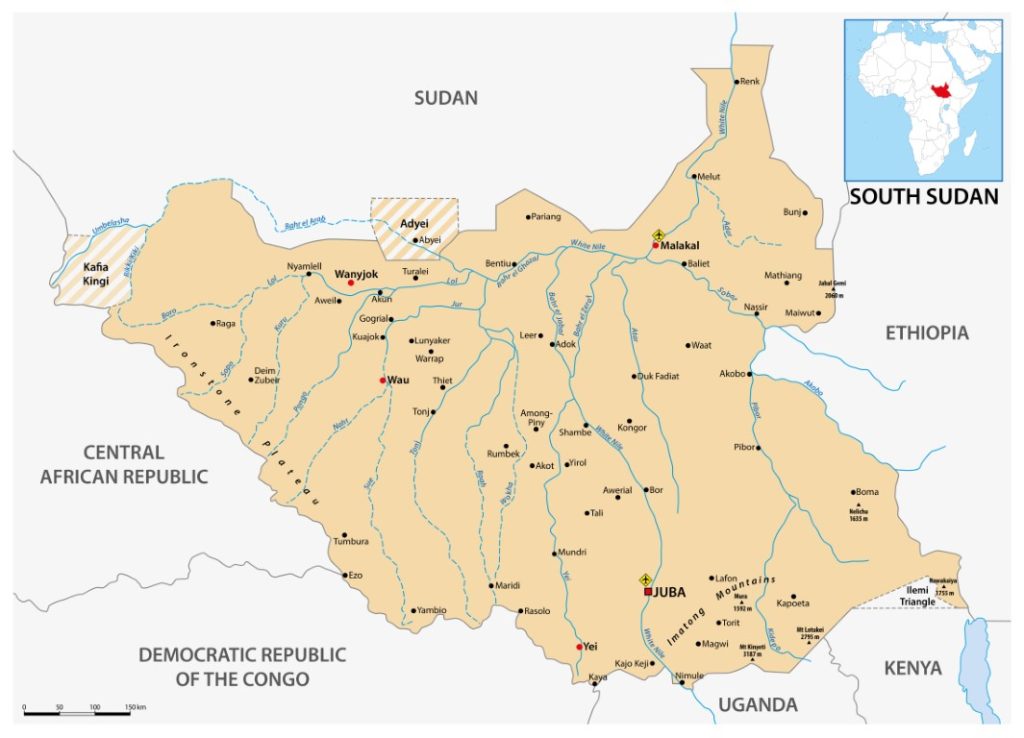
The map of South Sudan highlights its strategic position in East Africa. The country shares its borders with Sudan to the north, Ethiopia to the east, Kenya and Uganda to the south, as well as the Central African Republic and the Democratic Republic of the Congo to the west. Its territory is marked by vast savannas and the White Nile, which crosses the country from south to north.
Armed conflicts, security, and population displacement
South Sudan remains sadly associated with its internal armed conflicts that closely followed independence. A new civil war broke out in 2013, pitting supporters of President Salva Kiir against those of Vice President Riek Machar. The clashes took on an ethnic dimension, fueling violence in several regions.

The human consequences are severe. Population displacements and refugees mark the daily lives of many families. Thousands of people flee to the neighboring borders, notably to Uganda, Kenya, Sudan, and the Central African Republic. The capital Juba is not spared, nor are many isolated villages.
- Displaced persons camps inside the country host tens of thousands of survivors each year.
- The UN estimates that several million inhabitants still depend on humanitarian aid to meet their basic needs.
- Many choose to cross the borders and become refugees, mainly in East Africa.
These fragile contexts raise the question of security in South Sudan. Travel recommendations generally emphasize caution, given the persistence of localized tensions and potential risks for foreigners and humanitarian workers.
Additional points on the map of South Sudan
- The country is crossed by the White Nile, which is a vital resource and a major axis visible on the map.
- The Sudd, one of the largest swamps in the world, occupies a large part of the central territory.
- Its political map shows six borders with: Sudan, Ethiopia, Kenya, Uganda, the Central African Republic, and the DRC.
- The capital Juba is located on the banks of the White Nile, in the south of the country.
- South Sudan is among the African regions with the fastest population growth.
Political situation and emblematic leaders
South Sudanese political life is marked by major figures and a central governance often contested. The government struggles to establish lasting stability despite dialogue efforts.
Salva Kiir and the central power
President Salva Kiir holds an essential place in the political life of South Sudan. Recognizable by his famous black hat, he has led the government since independence. Under his presidency, the country has experienced as many dialogue efforts as periods of armed conflict. His ability to maintain balance among the different communities is often questioned, despite a declared desire to restore national unity.
The capital Juba centralizes power, becoming both a stage for democratic hope and a witness to institutional weaknesses. False promises and unfinished reforms sometimes undermine trust in central authorities, adding an extra layer of political uncertainty.
Riek Machar, rivalry and search for balance
Riek Machar symbolizes the recurring opposition within the country. This former vice president often represents a key figure of dissent, oscillating between political dialogues and violent resurgences of armed struggle against the established power. His regular return to the forefront illustrates the difficulty of finding lasting stability.
The tense relations between the two men mark many recent political episodes. The agreements signed to end hostilities have never completely reassured the population, leaving doubt over the real political dynamic.
Population, demography and linguistic diversity
With more than 60 ethnic groups recorded, the population of South Sudan is one of the most diverse in Africa. Each community brings a language, customs, and a particular way of conceiving national identity. Arabic, once dominant, is gradually giving way to English, now the official language, while Dinka, Nuer, and Shilluk are among the major languages of the country.

This plurality poses real challenges when developing inclusive policies. Each group claims a legitimate place in the state apparatus, which sometimes makes fair representation of the different groups difficult. Schools, radio, and administration try, more or less successfully, to juggle between these different languages and identities.
- Nearly 12 million inhabitants live in South Sudan according to available estimates, figures made uncertain by the unstable situation.
- Frequent censuses seek to better understand the social structure and local demographic evolution.
- Repeated population displacements continuously change the ethnic and human map of the country.
Borders, capital and relations with neighbors
The geographical position of South Sudan shapes its foreign relations and internal organization. The country must deal with its neighbors and its strategic capital.
Capital Juba and strategic role
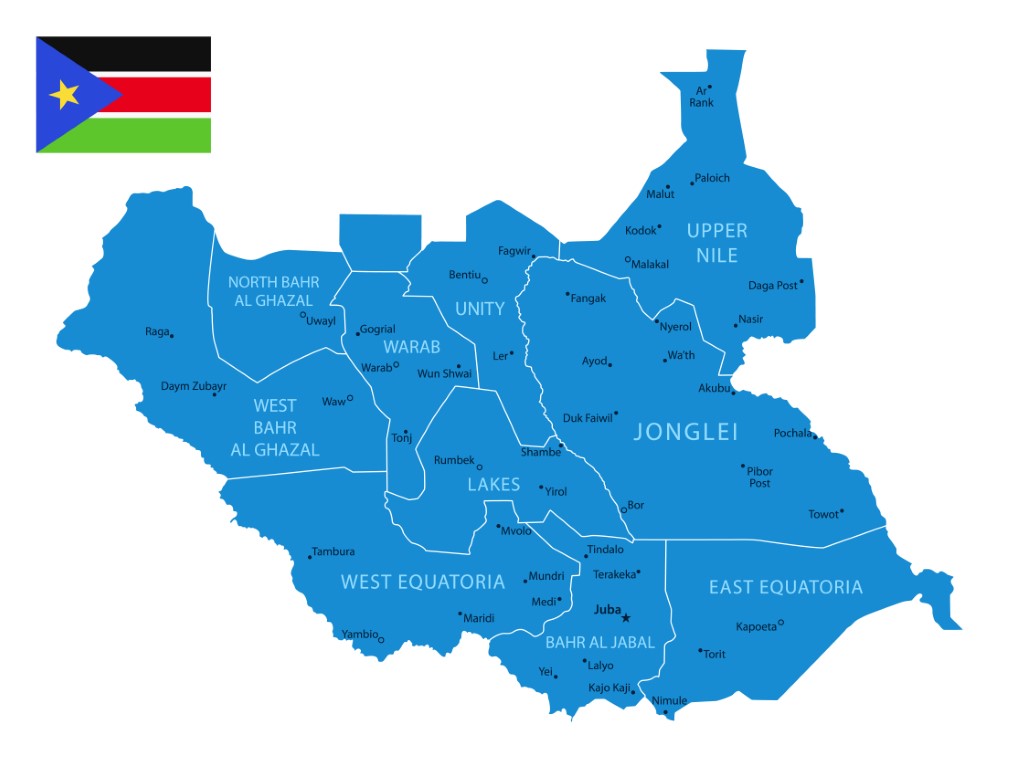
Located on the banks of the White Nile, the capital Juba (also called Djouba) occupies a pivotal position to govern the vast South Sudanese territory. A cosmopolitan city, it hosts ministries, international organizations, and diplomatic actors. Between modern constructions and lively markets, it plays a central role in the reconstruction of the country, even though it must deal with the remnants left by the civil war.
Juba is also a transit hub for goods coming from the main regional partners. Through its still improvable infrastructures, the city tries to connect the different provinces and offer a more stable image to visitors.
Neighboring countries and regional diplomacy
The borders of South Sudan often attract attention, as they form a mosaic of exchanges, affinities, and also tensions. The country shares its borders with six neighbors: Sudan, Ethiopia, Kenya, Uganda, the Central African Republic, and the Democratic Republic of the Congo. This geography requires managing varied strategic and economic interests.
International relations and diplomacy remain dominated by the search for external support, whether for humanitarian programs or trade agreements. The armed conflicts with neighboring Sudan, not to mention the regular border incidents, complicate these efforts. Building lasting bridges with neighboring states appears as a priority to stabilize the region.
Outlook and daily life
The inhabitants of South Sudan deal daily with the uncertainty linked to their environment. Although society is very resilient, many dream of new opportunities, access to quality education, or better medical care.
Rural life predominates, with a strong dependence on agriculture and traditional livestock farming. Despite this, modernization projects are emerging, driven by a youth determined to turn the page on conflicts. This collective quest for the future contrasts with the often complicated daily life of a large part of the population.
FAQ – South Sudan map: 3 questions
South Sudan became independent on July 9, 2011, making it the youngest state in the world.
The capital is Juba, located on the banks of the White Nile.
The country is distinguished by its plains, savannas, swamps (the Sudd), and by the presence of the White Nile that crosses it.
