
What you need to know about Egypt ?
Egypt is a country located at the junction of Northeast Africa and Asia, the latter including the Sinai Peninsula. Officially called the Arab Republic of Egypt, it is one of the oldest and most influential states in the Arab world.
Its capital, and largest urban area, is Cairo, the true political, cultural, and economic heart of the country.
The Egyptian territory covers a total area of about 1,001,450 km² and is home to nearly 104 million inhabitants (2024 estimates), making it the 30th largest country in the world and the 15th most populous.
Egypt is also the 4th most populous country in Africa, after Nigeria, Ethiopia, and the Democratic Republic of the Congo.
The official currency is the Egyptian pound (EGP) and the country’s international telephone code is +20 (or 0020).
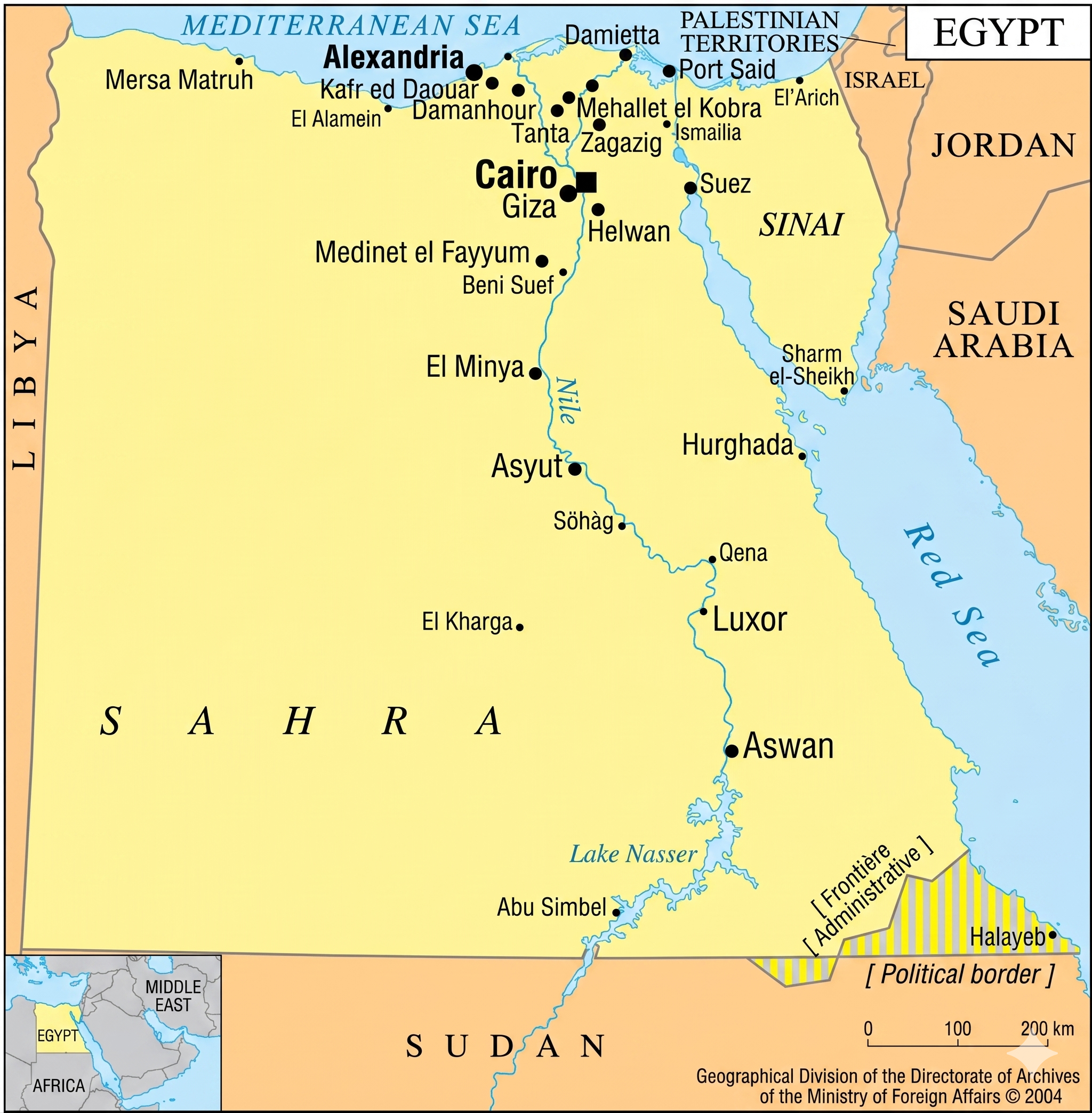
A country sandwiched between the Mediterranean and the Red Sea, shaped by the Nile: 95% of the territory is desert, but life is concentrated along the river. Use the map to connect Cairo and Giza, the Nile Valley (Luxor–Aswan), and the Red Sea coast. Aim for autumn and spring for milder temperatures and comfortable sightseeing.
| Element | Details |
|---|---|
| Official Name | Arab Republic of Egypt |
| Capital | Cairo |
| Population | ~110 million inhabitants (high concentration in the Nile Valley and Delta) |
| Area | ~1,010,000 km², mostly desert (Sahara) |
| Relief and Hydrography | Nile Valley, Nile Delta, desert plateau, Mount Sinai, Mediterranean and Red Sea coasts |
| Climate | Arid desert; mild on the Mediterranean coast, very hot in summer inland |
| Major Cities | Cairo, Alexandria, Giza, Luxor, Aswan, Sharm el-Sheikh, Hurghada |
| Language | Arabic (official); English/French for tourism |
| Currency | Egyptian Pound (EGP) |
| Economy | Tourism, Suez Canal, Nile agriculture, hydrocarbons |
| Points of Interest | Pyramids of Giza, Valley of the Kings (Luxor), temples (Karnak, Abu Simbel), Red Sea reefs |
| Access | Cairo, Hurghada, Luxor, Sharm el-Sheikh airports; Nile Valley railway network |
| Tips | Plan hydration/UV protection, adapt clothing for religious sites, favor early morning visits in summer |
Egypt’s neighboring countries
Egypt’s neighboring countries are Libya, Sudan, Israel, and Saudi Arabia. These countries border it respectively to the West, South, North-Northeast, and Northeast. The country borders the Red Sea to the East and the Mediterranean Sea to the North.
The colors of Egypt
The Egyptian flag is a rectangular flag made up of 3 horizontal bands of equal size. From top to bottom, red, white, and black. In the center of the flag on the white band are the national coat of arms. The red color represents the 1952 coup d’état.

The white color represents the peaceful struggle during that time. The black color represents the end of British colonization. The national coat of arms represents the Eagle of Saladin, which was the symbol of the Egyptian Vizier of the 12th century.
The best places to visit in Egypt
Alexandria
Founded by Alexander the Great, Alexandria was once one of the greatest metropolises of the ancient world. Famous for its legendary library and its lighthouse, one of the Seven Wonders of the World, it today preserves a unique blend of Greek, Roman, and Arab influences.
A modern and lively coastal city, Alexandria charms with its Mediterranean beaches and elegant atmosphere. The Qaitbay Citadel, built in the 15th century, overlooks the sea and embodies the city’s historical power.


Luxor
A true open-air museum, Luxor houses the greatest treasures of Pharaonic Egypt. Crossed by the Nile, the city is home to the temples of Karnak and Luxor, as well as the Valley of the Kings.
Each monument tells the grandeur and spirituality of the pharaohs’ era, offering a fascinating immersion into 4,000 years of history.
Cairo
Vibrant capital with over 22 million inhabitants, Cairo combines urban chaos and cultural richness. Here you can discover the Egyptian Museum, the millennial mosques, and of course the Giza pyramids, just a few kilometers away.
In the evening, the downtown alleys come alive with markets, cafés, and Oriental music.
Aswan
Located in the south of the country, Aswan offers a more peaceful atmosphere, marked by the beauty of the Nile and lush islands. It is the ideal starting point to visit the Philae temples or sail to Abu Simbel, a masterpiece carved into the rock.
Its warm and dry climate makes it a pleasant destination in winter.
Hurghada
Former fishing port turned popular seaside resort, Hurghada attracts enthusiasts of scuba diving and relaxation. Its turquoise waters of the Red Sea harbor spectacular coral reefs, while the city offers a relaxed atmosphere, perfect for extending your trip between sea and desert.
Financial map of Egypt

Egypt today has one of the most dynamic economies on the African continent, driven by sustained growth and a gradual diversification of its sectors.
Its economy rests on several pillars: manufacturing industry, mining and oil extraction, tourism, as well as foreign trade (import-export) with its regional and international partners.
Egyptian exports, notably in crude oil, agricultural products, fertilizers, textiles, and fruits and vegetables, generated nearly 23 billion dollars in revenue in 2024, significantly contributing to the country’s trade balance.
Key economic data (2024-2025 Estimates)
- Official currency: Egyptian Pound (EGP)
- Nominal GDP: 403 billion USD
- GDP in purchasing power parity (PPP): 1,740 billion USD
- Annual GDP growth: approximately 4.1%
- GDP per capita (PPP): approximately 13,000 USD
- Inflation rate: approximately 23%
- Population below the poverty line: approximately 25%
- Unemployment rate: approximately 12%
Despite high inflation and persistent monetary tensions, Egypt maintains a strong economic potential, supported by its structural reforms, major infrastructure projects (such as the new administrative capital), and its strategic positioning between Africa, the Middle East, and Europe.
Climate map of egypt
Egypt features two types of climates: Mediterranean along the coasts including Alexandria, and Semi-desert in the areas surrounding the capital. The climate in the southern part is also desert.
Autumn in the country generally occurs between September and November with maximum sunshine and temperatures ranging between 25 and 35°C. Rainfall is rare during this period.
Winter is marked by frequent precipitation and strong wind exposure. This season occurs between December and February.
During this time, the Red Sea is cool and nights in arid zones are cold while the rest of the country is sunny.
Spring is the shortest season but is marked by heavy rains that occur unexpectedly. Temperatures during this season range from about 20°C minimum to 40°C maximum. Spring falls between March and April.
Summer is an extremely hot, even scorching season. However, it is less pronounced along the Mediterranean coasts and very pronounced in the southern areas. Temperatures can even reach 50°C.
Demographic, demolinguistic, and administrative map of Egypt


Demographics of Egypt
The population of Egypt is estimated at about 104 million inhabitants in 2024, with a population growth rate of 2.2% per year — one of the highest in the Arab world.
The fertility rate is 3.3 children per woman, reflecting a young and rapidly growing population.
The birth rate is about 28.8 ‰, while the death rate remains low, around 4.5 ‰. This difference explains the steady growth of the Egyptian population.
The life expectancy at birth is 73.2 years, with an average of 71.8 years for men and 74.7 years for women.
The male/female ratio is 1.04, or about 104 men for every 100 women, and the net migration rate is slightly negative (-0.4%), mainly due to temporary economic departures to the Gulf.
The official language is Arabic, spoken by more than 99% of the population. The majority religion is Islam, practiced by about 90% of Egyptians, while the Coptic Christian minority represents about 10% of the population.
Administrative divisions of Egypt: the map


The Egyptian territory is subdivided into 27 governorates which are then divided into municipal levels called Markaz and Kism, numbering 162 and 177 respectively. There are also 9 new cities and 3 areas administered by the police. Finally, there are unorganized zones.
Here are the governorates of Egypt:
Alexandria
Aswan
Asyut
Beheira
Beni Suef
Cairo
Dakahlia
Damietta
Faiyum
Gharbia
Giza
Ismailia
Kafr El Sheikh
Luxor
Matruh
Minya
Monufia
New Valley
North Sinai
Port Said [5]
Qalyubia
Qena
Red Sea
Sharqia
Sohag
South Sinai Governorate
Suez
Demolinguistic data
The Egyptian population mainly descends from the Hamito-Semitic stock, one of the oldest ethnolinguistic groups on the African continent. The civilizations that developed along the banks of the Nile — notably that of Pharaonic Egypt — shaped a unique cultural identity, at the crossroads of Africa and the Middle East.
The official language of Egypt is Arabic, but the population mostly speaks a local variety called Egyptian Arabic (or Masri). This dialect, used in the media, music, and cinema, is understood throughout the Arab world.
Here are the main varieties of Arabic spoken in Egypt:
- Egyptian Arabic (Masri): 66.7%
- Sa‘idi Arabic (or Upper Egyptian Arabic): 23.1%
- Sudanese Arabic: 1.6%
- Bedawi Arabic (Bedouin of Sinai and the East): 1.1%
- Maghrebi Arabic (Moroccan and Algerian, minorities): about 3.4% in total
- Gulf and Levantine Arabic (present through recent migrations and foreign communities): less than 1%
- Modern Standard Arabic (Fusha): used in administration, media, and education.
Thus, although Egyptian Arabic is the dominant dialect and culturally the most influential in the Arab world, Egypt retains a great internal linguistic richness, reflecting its history, migrations, and regional exchanges.
FAQ: Egypt Map
For a useful Egypt Map, prioritize a base with roads, train stations, and airports, plus a zoom on the Nile Valley and the Red Sea resorts.
Yes, an Egypt Map showing the valley and the delta visualizes the high density around the river in contrast with the desert areas.
Opt for an Egypt Map including urban/archaeological plans or detailed inserts around the main sites and transport routes.
