
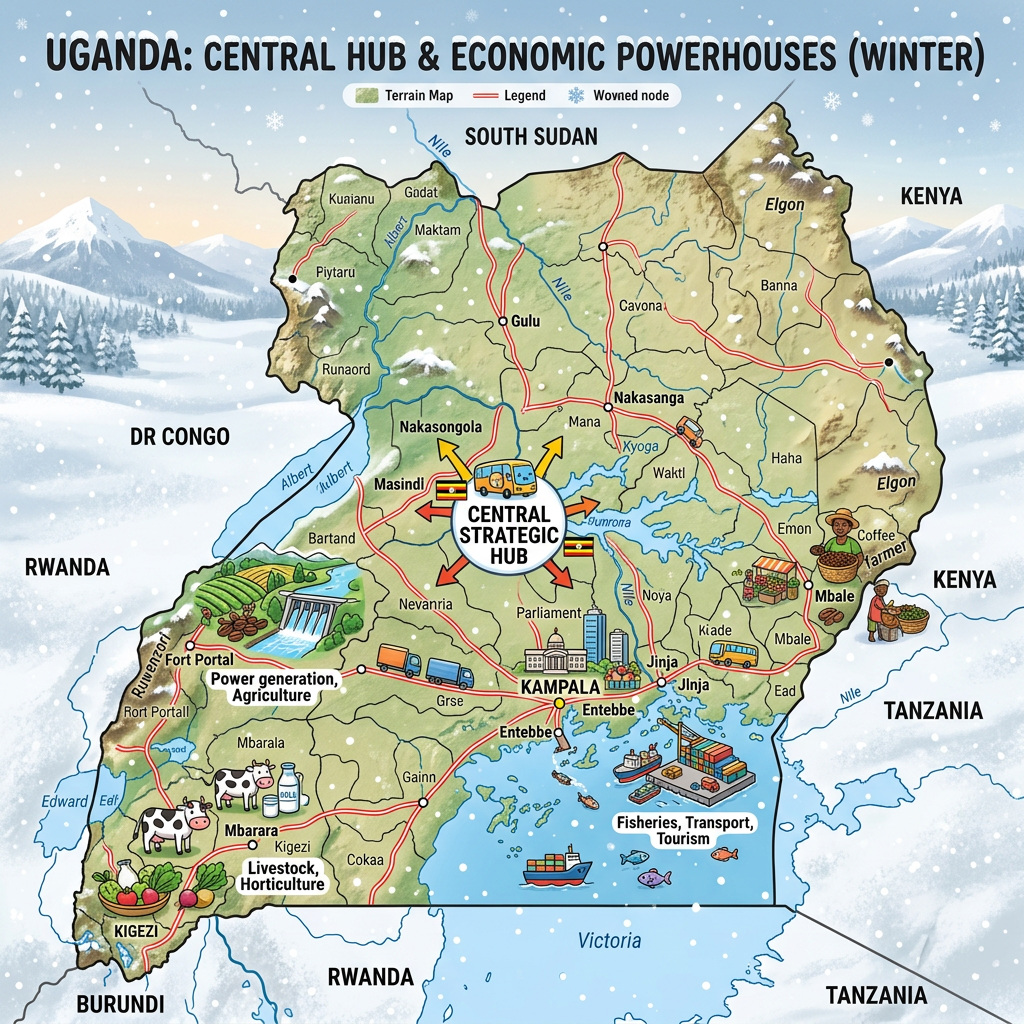
What you need to know about Uganda ?
Uganda, officially known as the Republic of Uganda, is a sovereign country located in East Africa. It covers an area of 241,550 km² and has an estimated population of around 52 million inhabitants in 2026. Its capital and largest city is Kampala. The country is a member of several international and regional organizations, including the Common Market for Eastern and Southern Africa (COMESA), the African Development Bank (AfDB), the International Conference on the Great Lakes Region (ICGLR), the International Bamboo and Rattan Organization (INBAR), and the G33. Its international calling code is +256.
Colors of Uganda
The Ugandan flag consists of 6 horizontal colored stripes: black, yellow, red, black, yellow, and red. In the center of the flag, there is a white disc with a grey crowned crane inside.

Best places to visit in Uganda
Entebbe: It is a major city in the country, it has an international airport and is located on the shores of Lake Victoria. There is also a national park called the Uganda Botanical Garden.
Kampala: The capital of the country is also its largest city. It is a dream destination for adventurers but also for businessmen. There is the Gaddafi Mosque, the Kabaka’s Palace, and the Bahá’í Temple.
Mbarara: It is a city located in the western part of the country. It mainly serves as a starting point for those wishing to visit Bwindi and Queen Elizabeth national parks.
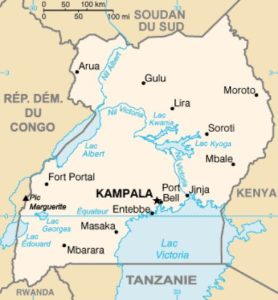
Where is Uganda located ?
On the world map, Uganda is located in Africa. More precisely, it is situated on the eastern plateaus of continental Africa. Its neighbors are: the DRC, Kenya, Rwanda, Sudan, and Tanzania.
Climate in Uganda
The climate of Uganda is classified as tropical. Temperatures throughout the year hover around 20°C. The northern section is hotter with lower humidity, mountainous areas are cooler, and snow can occur at the summit. The hot period mainly occurs between December and February, and the rainy periods between April and May.
Administrative division of Uganda
The Ugandan territory is divided into 4 administrative regions which in turn are composed of 121 administrative districts and 146 counties. Here are the 4 administrative regions: Central, Western, Eastern, Northern.

Economy of Uganda
Uganda’s economy is primarily agricultural with 80% of the active population working in this sector. The growth of this economy is low due to the regional context.
- Official currency: Ugandan Shilling
- Nominal GDP: approximately USD 66 billion
- Annual GDP growth rate: approximately 6.2%
- GDP per capita at Purchasing Power Parity (PPP): approximately USD 3,700
- Inflation rate: approximately 4.2%
- Population living below the national poverty line: approximately 42%
- Government revenue: approximately USD 8.5 billion
- Public debt: approximately USD 29 billion
Population and linguistic data of Uganda
Uganda has an estimated population of around 52 million inhabitants in 2026. Its annual population growth rate is approximately 2.7%, with a birth rate of around 36‰ and a death rate of about 6‰.
Life expectancy at birth is approximately 68 years. The median age is 16.9 years, making Uganda one of the countries with the youngest populations in the world.
FAQ – Uganda map: Geographic and demographic information
Uganda is a landlocked country located in East Africa, at the heart of the Great Lakes region. It shares borders with Kenya, Tanzania, Rwanda, the Democratic Republic of the Congo, and South Sudan.
Uganda has a population of approximately 52 million people in 2025. Its population is predominantly young and is experiencing one of the fastest demographic growth rates in Africa.
Uganda covers an area of approximately 241,550 km². Its territory consists of plateaus, mountains, lakes, and vast savanna regions.
