
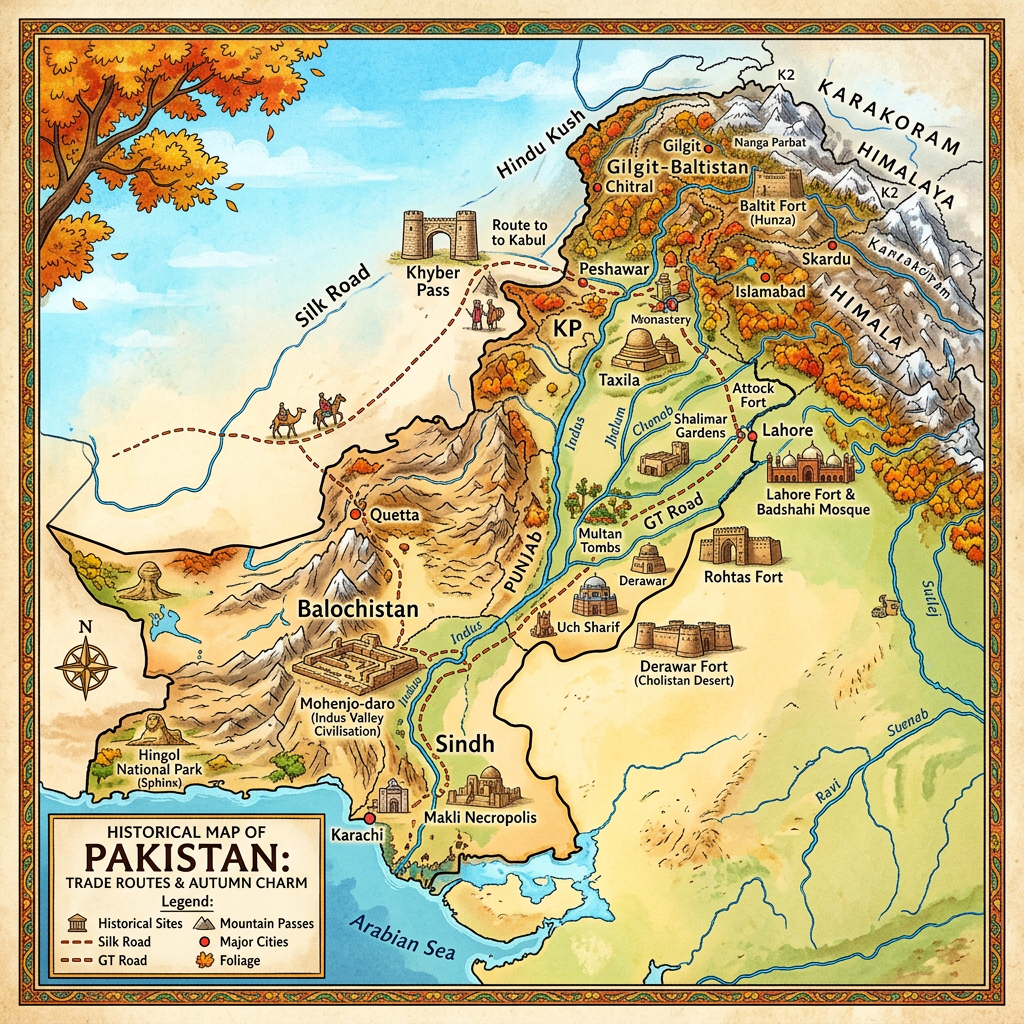
The 5th most populous country in the world is Pakistan. It is a country located in the southern part of Asia. Its population today amounts to 212 million inhabitants and it is a Muslim country.
What you need to know about Pakistan ?
Its area currently amounts to 881,913 km2 which ranks it 33rd in terms of area. The length of the Pakistani coastline currently measures 1046 km, stretching from the Arabian Sea to India. The capital of the country is Islamabad and its largest city is Karachi. The official language is Urdu and the second language is English. The Pakistani telephone code is 92 or 0092 or +92.
Which countries border it?
The bordering countries of Pakistan are: India, Afghanistan, Iran, China. Tajikistan is separated from the country by a small corridor called Wakhan. The country is also separated from the sea by Oman.
Population of Pakistan
Currently, the Pakistani population amounts to 223,185,717 inhabitants according to the latest United Nations data. This population represents 2.83% of the global population. Pakistan is now the 5th most populous country in the world with a density of 742 inhabitants per km2 and relative to its area of 770,880 km2. More than a third of the population (35.1%) is urban and the average age in Pakistan is 22.8 years, indicating a very young population.
What are the colors of the country?

The Pakistani flag features a green background, a white stripe on the hoist side, and a crescent moon with a star to its right.
- The white stripe: represents the ethnic and religious minorities who are non-Muslim.
- The green color is also called Pakistani green and indicates the Islamic majority.
- The crescent symbolizes the Muslim religion.
What are the best cities to visit in Pakistan?
Lahore
Located at the confluence of the Ravi River, the city of Lahore is a densely populated city and ranks 45th in the world. It is a university city but also the territory where several cultural movements take place. Its main architectures include: the largest mosque in Asia also known as the Royal Mosque. The city of Lahore is also known for being a capital of Lollywood production, a very large film producer.

You will also enjoy visiting the Shalimar Garden and the Shahdara Garden, two gardens worthy of postcard settings. Other attractions include: the Wazir-Khan Mosque, Government College University, Bawa Dinga Singh, Ferozsons Library, King Edward Medical University, Asif Khan Mausoleum, the tomb of Mohamed Iqbal.
Karachi
The city of Karachi is the largest urban area in Pakistan. It is also the economic center of Pakistan and one of the cities with a very high population density. It is the former capital of Pakistan, filled with famous monuments such as the Mausoleum of Muhammad Ali Jinnah, the founder of Pakistan. You can also visit: Masjid E Tooba, Frere Hall, Clifton Beach, Mohatta Museum, Pakistan Air Force Museum, Wazir Mansion.
Islamabad
It is the capital of Pakistan and is a relatively new city compared to the others we present to you. It is also close to the Indian border. It is the cradle of the country’s political leadership with several residences and administrative offices such as Aiwan-e-Sadr, which is the presidential residence, the Parliament House, and the Faisal Mosque, which is one of the largest in the world.
Built on a plateau named Pothohar and bordered by hills, the territory of Islamabad is very interesting. Indeed, you can see other cities from afar, from other provinces such as Lahore and Faisalabad. You can also see the northern frontier province.
In addition to the Parliament House and the Pakistan House, it is also an interesting university city, the most famous being Quaid-i-Azam.
Naran
Naran is a small village in Pakistan; it is the capital of the Khyber Pakhtunkhwa province. The city attracts tourists from around the world especially because of its warm and humid climate during the summer. The main attractions in the city are Gilgit Hunza, Babusar Pass, Naran Bazaar, all of which are magnificent places and the gateways to the city. You can also enjoy various hotels and restaurants offering delicious dishes.
Where the cities are located on the Pakistan map ?

Lahore
On the Pakistan map, the city of Lahore is located near the Indian border, only 30 km away from it. Geographic coordinates: 31° 32′ 32″ north, 74° 20′ 04″ east
Karachi
On the Pakistan map, the city of Karachi is a port city facing the Indian Ocean. Geographic coordinates: 24° 51′ north, 67° 00′ east
Islamabad
On the Pakistan map, Islamabad is located in the northern section of the city and in the middle of the federal territory of the same name. Geographic coordinates: 33° 43′ north, 73° 04′ east.
Naran
On the Pakistan map, the city is located in the northern inland section. The city of Naran is 117 km away from the capital Islamabad and only 5 km from the Indus River. Geographic coordinates: 33°38′20″N 72°3′11″E
Pakistan climate map
Pakistan experiences climate variations depending on the regions and external influences (winds, maritime influences). In the North and northern parts, the climate is strongly influenced by the monsoon. Consequently, two seasons exist which are the dry season and the wet season, occurring respectively between November-April and May-October. The climate in the southern inland section is similar to that of the northern part.
The southern part of Balochistan and Sindh experience two types of climates which are desert climate and arid-semi-arid climate. In the center of the country, the climate is tropical humid. It is also an area strongly influenced by the monsoon which blows strongly between June-September.
Islamabad
The climate in the capital is also influenced by the monsoon. This wind brings abundant precipitation between the months of July and September. The climate of the capital is therefore characterized as a tropical humid climate. This climate is characterized by mild winters (temperatures above 0°C). Summers are hot with temperatures that can exceed 38°C between June and July.
Karachi
The location of this city inside the Indus Delta strongly influences its climate. Moreover, the city’s topography shows very little elevation changes which induces a hot desert climate. Between July and August, significant precipitation occurs. The summer season is very hot and the cold seasons (winter) are milder. The aforementioned precipitation mostly occurs during the summer months and amounts to approximately 167 mm. The average annual temperature is 27°C which clearly indicates a desert climate.
Economic map of Pakistan
In terms of economic performance, Pakistan ranks as the 27th most performing country in the world. The country’s GDP currently stands at 430 billion USD and its population of 180 million inhabitants has a purchasing power of 2624 USD in nominal parity.
Pakistan has several advantages that could allow its economy to develop rapidly. These assets include: a large workforce, a very large arable area, and a diverse climate. Unfortunately, the Pakistani economy has not been able to adapt and evolve over time due to politics and administrative instability. Furthermore, the country is weak in energy resources which certainly hampers its prosperity.
Here are some economic indicators of Pakistan:
- Official currency: Pakistani Rupee
- GDP in nominal parity: 303.5 billion USD
- GDP in PPP: 1021.2 billion USD
- Annual GDP growth rate: 5%
- GDP per capita in PPP: 2,600 USD
- Inflation rate: 11.7%
- Population living below the poverty line: 23%
- HDI: 0.551
- Number of active population: 99.18 million inhabitants
- Unemployment rate (% of active population): 15.2%
Administrative and demolinguistic data
Administrative subdivisions
4 provinces and one federal territory constitute the main subdivisions of Pakistan: These are: the provinces of Balochistan, Punjab, Sindh, Khyber Pakhtunkhwa, and the territory of the capital Islamabad. The latter is autonomous and is governed by an effective territorial administration.
There are also two other autonomous territories governed by the country, which are Gilgit-Baltistan and Azad Jammu and Kashmir. Pakistan also aspires to govern the old regions of the State of Junagadh and the State of Munavadar, which are still under Indian control.
After the provinces and autonomous territories, there are the districts (130 including the capital and 14 districts dependent on Gilgit Baltistan), then the tehsils. These are further subdivided into union councils.
Here are the groupings of the districts
- Pakistan (5)
- Azad Jammu and Kashmir (1)
- Gilgit-Baltistan (1)
- Balochistan (33)
- Khyber Pakhtunkhwa (33)
- Punjab (36)
- Sindh (29)
- Districts of Azad Jammu and Kashmir (10)
- Districts of Gilgit Baltistan (14)
Demolinguistic data
Currently, the languages used in Pakistan number 12, of which 5 are spoken by nearly 10 million Pakistanis. These are: Punjabi, Pashto, Sindhi, Saraiki, and Urdu.
On the other hand, the official language of the country is Urdu, which is the main language, and English is the second language.
The other dialects spoken in Pakistan are:
- Punjabi
- Saraiki
- Pashto
- Sindhi
- Balochi
- Gujari
- Kashmiri
- Hindko
- Brahui
- Shina
- Balti
- Khowar
- Dhatki
- Haryanvi
- Marwari
- Wakhi
- Burushaski
FAQ – Pakistan map: Geographic and demographic information
Pakistan is located in South Asia, bordered by India, Afghanistan, Iran, and China, with a coastline along the Arabian Sea. Its strategic location makes it an important crossroads between Central Asia, South Asia, and the Middle East.
Pakistan has a population of over 250 million people, making it one of the world’s most populous countries. Its population is relatively young and continues to grow steadily.
Pakistan features a wide variety of landscapes, ranging from the high mountains of the Himalayas and Karakoram to the fertile plains of the Indus Valley, as well as deserts and plateaus. This geographical diversity has a significant impact on the country’s climate, economy, and population distribution.
