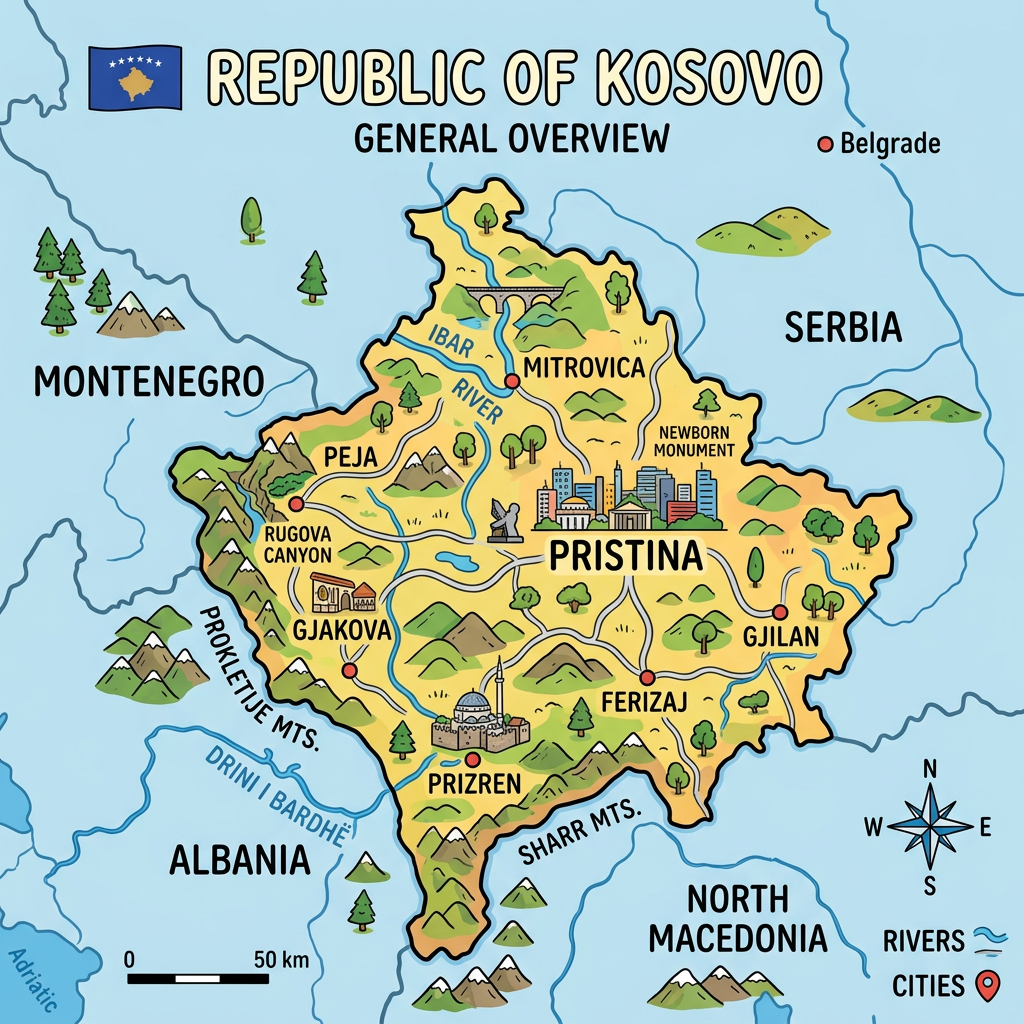
Located in the Balkans, Kosovo is a small country with great cultural and natural diversity. Enjoy its unique charm on your next trip by exploring the many tourist attractions it has to offer. In this article, we will present the map of Kosovo, its mountainous landscapes, must-see sites to visit, its religion, and its history marked by war.

We will also cover practical information such as transportation, the airport, when to go, budget, and formalities to make your stay easier.
The countries bordering Kosovo are Serbia, Montenegro, Albania, and North Macedonia.
Discovering Kosovo: What to do on site?
Kosovo has an area of 10,908 km² and is mostly made up of mountainous and hilly regions. This gives it an incomparable natural beauty, ideal for outdoor activities such as hiking or mountain biking.
Must-see sites to visit
- Pristina: The capital of Kosovo, Pristina, is a dynamic and cosmopolitan city that combines modernity and tradition. Be sure to visit the Newborn national monument, the Orthodox Church of Christ the Savior, as well as the Ethnographic Museum.
- Peja: Located in the west of the country, Peja is surrounded by majestic mountains and has a rich history. You can discover the Patriarchate of Peć, an important Orthodox religious site listed as a UNESCO World Heritage site, as well as the Rugova gorges and the Bjeshkët e Nemuna National Park.
- Prizren: Considered one of the most beautiful cities in Kosovo, Prizren charms with its medieval allure and its many historical monuments, including the Kalaja fortress and the Sinan Pasha mosque.
Tourism in Kosovo: transportation, airport, and road map

To get around Kosovo, several options are available to you:
- The car is a practical way to travel in Kosovo thanks to a relatively well-maintained road map. You can rent a car directly at Pristina airport or in the main cities of the country. Keep in mind that some mountain roads can be difficult to navigate in winter.
- The intercity bus network serves all the main cities of the country, with regular and inexpensive connections. However, it is recommended to check the schedules in advance, as they may vary from one region to another.
- Finally, it is possible to travel by taxi provided you negotiate the price in advance, especially if you plan to go outside the major urban areas.
Pristina International Airport (PRN) is the main entry point for foreign travelers. It offers direct flights to and from several European cities, including Istanbul, Vienna, Geneva, and Zagreb.
When to go, budget, and money ?
- Ideal period: The best time to visit Kosovo is undoubtedly summer, when temperatures are pleasant and the sun shines on the surrounding mountains. However, since the tourist season is less intense than in other European countries, it is possible to visit Kosovo off-season without fearing crowds.
- Budget: The cost of living in Kosovo is generally lower than that of its neighbors, making it an affordable destination for a trip in Europe. Expect to spend between €30 and €60 per day per person for a moderate budget, including accommodation, meals, and tourist activities.
- Money: The official currency in Kosovo is the euro (EUR), even though the country is not part of the European Union. ATMs are common in major cities, but you should carry enough cash for purchases in more rural areas.
Entry formalities and religion
- Visa: Nationals of many countries, including the European Union, the United States, and Canada, can enter Kosovo without a visa for stays under 90 days. However, make sure you have a passport valid for the duration of your stay.
- Religion: The majority of the Kosovar population practices Sunni Islam, while Orthodox Christians represent a significant minority. Travelers are encouraged to respect local customs and places of worship during their visit.
Kosovo and the war: History of a country marked by conflicts
During the 1990s, war broke out in the Balkans between Serbian forces, led by Slobodan Milosevic, and the Albanian population of Kosovo. This dark period in the country’s history had a profound impact on its society, but today, 20 years after the end of the conflict, Kosovo continues its process of reconstruction and reconciliation with its neighbors. It is important for tourists to be sensitive to this history when visiting the country and its monuments related to this troubled era.