
What you need to know about the Puy-de-Dôme department ?
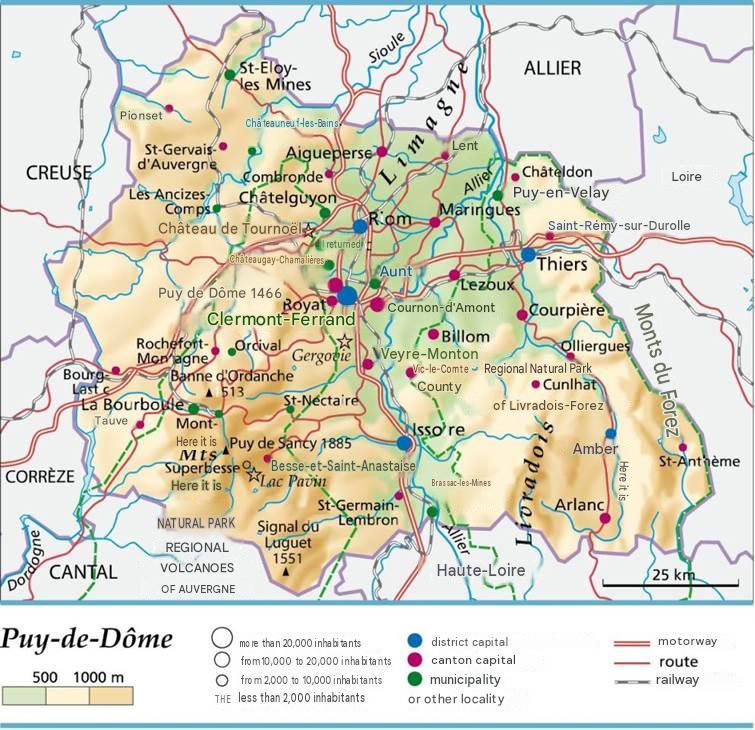
We will introduce you to the Puy-de-Dôme area, an inland administrative zone in the center of the country. Furthermore, the region to which this branch belongs is the Auvergne-Rhône-Alpes region. Previously, the area covered by the 63rd Division was the domain of the Lower Auvergne Country. Frankly, this is important for the partition of the Auvergne region.
It may indeed be the oldest division since the French uprising of 1790. The former name of the division was Mont-d’or. The capital of the province is a state called Clermont-Ferrand, and its sub-states are called Thiers, Isour, Amber, and Riome. Moreover, it is a department governed by a deputy and therefore an emissary (prefect).
Furthermore, regarding demographics, the inhabitants of Puy-de-Dôme currently number 664 453 people, and the department covers an area of 7,970 km², which means that the population density is 83 inhabitants per square kilometre. In addition, the Puy-de-Dôme department is organised into 5 arrondissements, 5 legislative constituencies, 31 cantons, 14 intermunicipalities, and 464 municipalities.

Which departments border the Puy-de-Dôme department?
As Puy-de-Dôme is an integral part of the Auvergne-Rhône-Alpes region, its neighbors are mainly: Creuse, Allier, Cantal, Corrèze, Loire, and Haute-Loire.
What is the climate like in the Puy-de-Dôme department?
Due to its location in the country and its rugged geography, crossed by the westerly wind current, it is an area with abrupt climatic changes, from mountain to plain and from maritime to continental type, creating a highly variable climate.
Subsequently, precipitation varies greatly, from the driest places to the wettest. The mountains in the Southwest (Sancy, Cézallier) are heavily watered and snow-covered, while the central Limagnes are protected by a strong foehn wind effect and see an overall increase in thunderstorms and precipitation. To the east, the foehn diminishes as it moves toward the other obstacle of the Livradois and Forez mountains.
Puy-de-Dôme is probably the most stormy area in France: daytime storms are extremely frequent, sometimes violent. This is due to the area’s topography: levels, slopes, vaults, volcanoes increasing lightning.
The relief of the Auvergne region is iron-rich, and the volcanoes in this sector also contribute, as well as the influence of air masses: heavy and urban air from Auvergne, warm air from the south of the central plateau, cool and urban air from the central section, and slightly sticky air coming from the Atlantic.
The typical temperature difference between the warmest and coldest parts of the field is 8°C. In any case, inversion properties make them systematically cooler than the mountains in winter.
What are the most important cities in the Puy-de-Dôme department?
To make this ranking, we referred to the size of each city in the Puy-de-Dôme department.
- Clermont-Ferrand
- Cournon-d’Auvergne
- Riom
- Chamalières
- Issoire
- Thiers
- Pont-du-Château
- Beaumont
- Gerzat
- Aubière

What are the largest municipalities in the Puy-de-Dôme department
To make this ranking, we referred to the area of each municipality in the Puy-de-Dôme department:
- Besse-et-Saint-Anastaise
- Anzat-le-Luguet
- Égliseneuve-d’Entraigues
- Saint-Genès-Champanelle
- Compains
- Saint-Anthème
- Ambert
- Saint-Ours
- Aydat
- Saint-Sauves-d’Auvergne
Regarding this second ranking of the municipalities in the Puy-de-Dôme department, we grouped them according to the population density per km2:
- Clermont-Ferrand
- Riom
- Issoire
- Beaumont
- Gerzat
- Cournon-d’Auvergne
- Chamalières
- Thiers
- Pont-du-Château
- Aubière
FAQ – Map of Puy-de-Dôme
A map of Puy-de-Dôme helps locate the main towns, volcanic landscapes, and various natural areas of the department. It also helps understand the organization of the territory between urban areas, mountains, and countryside.
A map of Puy-de-Dôme highlights Clermont-Ferrand, Riom, Issoire, and Thiers in particular. These towns are important centers for the department’s economy, culture, and tourism.
A map of Puy-de-Dôme is useful for planning a tourist itinerary or finding your way around the Auvergne region. It allows visitors to discover natural sites, villages, main roads, and must-see places throughout the area.
