
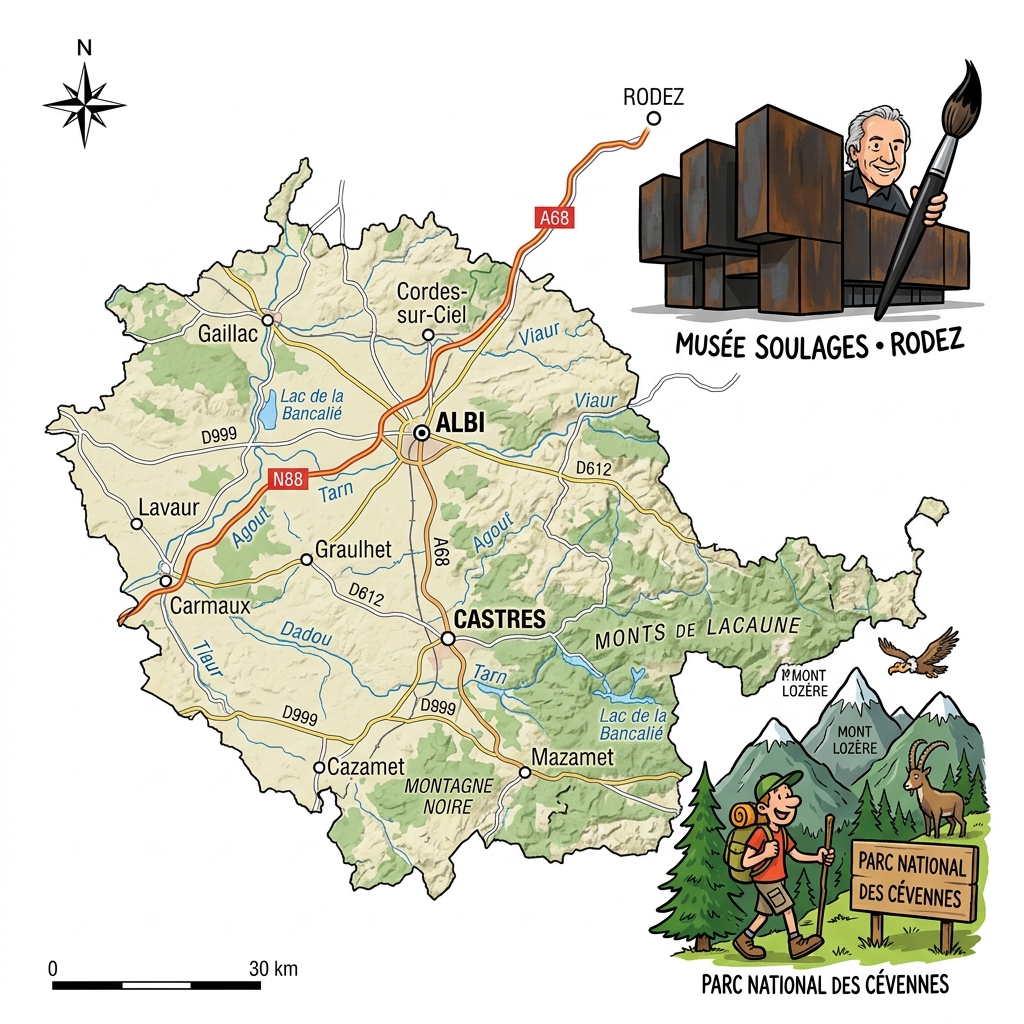
What you need to know about the Tarn department ?
We present to you here a department that is an integral part of the Occitanie region; it is actually the department numbered 81 in France. It is in fact the Tarn department, a name taken from the homonymous river that crosses the said department.
This department has a prefecture, which is also its largest city and its administrative center, called Albi. On the other hand, its sub-prefecture is the only one and is called Castres. Legally, department 81 is managed by the Toulouse Academy, mainly in the educational field. Furthermore, in judicial matters, the Toulouse Court of Appeal has full jurisdiction over the department.
Demographically, the population of the Tarn is currently 401,278 inhabitants, and given that the department’s surface area is 5,758 km², the density of inhabitants in department 81 is 70 inhabitants per km². Administratively, department 81 is divided into 2 arrondissements, 3 legislative constituencies, 23 cantons, 14 intercommunal entities, and finally, 314 communes.

Which departments border the Tarn department?
Since department 81, namely the Tarn department, is part of the Occitanie region, its neighbors are: the department of Aveyron, the department of Hérault, the department of Aude, the department of Haute-Garonne, and the department of Tarn-et-Garonne.
What is the climate like in the Tarn department?
The Tarn department actually has 3 distinct climates, namely:
The oceanic climate
The fact that the Tarn department is made up of a sort of amphitheater that opens to the west. Thus, the oceanic influence will mainly be felt in this part of the department. This could translate into a mild and humid winter period, a spring period with little rainfall, influenced by a moderately blowing west wind.
The mountain climate
This climate is mainly felt in the eastern and southern zones of the 81. The reason is that these areas are mainly mountainous. Moreover, there is a relief that quickly stops disturbances coming from the west and makes this area much wetter. Added to this is the fact that the temperature decreases with altitude and that the annual temperature variations hover around 4°C. There are at least 100 frost days per year, which allows some parts of this region to have hiking resorts and cross-country skiing areas during snowfall periods.
The Mediterranean climate
This type of climate is especially felt during times when the Autan wind blows. This characterizes the climate of Albi, Mediterranean par excellence. Geographically, there is a relief that greatly influences the climate because it blocks winds coming from the southern part of the department. As a result, the sheltered areas behind the relief are subjected to winds that act by producing a foehn effect. In regions with many vineyards, namely the Gaillac vineyard, there is a mild and dry period due to the wind, which greatly favors vine planting, especially between September and October. In the southern part of the Tarn department, there are also many thunderstorms that are far from weak.
What are the most important cities in the Tarn department?
We have listed these cities because they are the 10 best cities to visit in the Tarn department, so they are the 10 best tourist cities of the 81
- Albi
- Castres
- Graulhet
- Carmaux
- Saint-Juéry
- Gaillac
- Lavaur
- Bannières
- Saint-Sulpice-la-Pointe
- Puygouzon
What are the largest municipalities in the Tarn department?
To establish this ranking, we referred to the area of the municipalities in the Tarn department, so here are the 10 largest municipalities of the 81.
- Montredon-Labessonnié
- Castres
- Murat-sur-Vèbre
- Lacaune
- Castelnau-de-Montmiral
- Lisle-sur-Tarn
- Angles
- Puylaurens
- Paulinet
- Fontrieu

FAQ: Tarn map
The episcopal city of Albi is a UNESCO World Heritage site. The medieval village of Cordes-sur-Ciel also offers a magnificent view.
Summer is perfect for enjoying the sunshine and many festivals. Spring allows you to visit the countryside with mild temperatures.
A car is essential for exploring isolated rural villages. The train network efficiently connects the main towns of the territory.
